 Tel/WeChat:
  Email:


 Home
HomePowder Coating vs. Paint for Metal Parts: Which Finish Is More Durable and Cost-Effective?
 Published:2026-07-28 15:40:59
 212
212
Key Takeaways About Powder Coating vs Paint
Powder coating cures into a solid film through heat. Whereas paint forms a coating after solvent evaporation, chemical curing, or air drying, depending on the coating system.
Coating thickness, edge coverage, and surface uniformity vary between powder coating and paint processes.
Powder coating generally provides excellent resistance against abrasion, chipping, and outdoor exposure, making it suitable for long-term industrial applications.
Liquid paint offers greater flexibility for large structures, assembled products, field repairs, and localized maintenance work.
Production volume, curing equipment availability, coating thickness requirements, and future maintenance expectations all influence the selection between powder coating and paint.
Repair methods also differ. Powder-coated surfaces typically require recoating for consistent appearance, while painted surfaces can often be repaired locally.
The initial coating cost does not always represent the lowest lifetime cost. Long-term service conditions and maintenance requirements should also be considered.
Introduction: Powder Coating vs Paint
A metal component may meet every dimensional requirement after machining, forming, casting, and fabrication, yet its service performance can still depend heavily on the final surface finish.
Moisture, chemicals, UV exposure, abrasion, and daily handling gradually affect exposed metal surfaces. For this reason, the finishing process should be considered during the product design stage rather than treated as the final manufacturing step.
Powder coating and paint protect metal surfaces through different application methods. Each process involves different preparation requirements, application procedures, curing methods, inspection standards, and repair approaches.
These differences influence coating thickness, edge protection, surface appearance, production efficiency, maintenance requirements, and overall manufacturing cost.
No single finishing method is suitable for every project. The correct selection depends on the material, fabrication process, production volume, service environment, inspection requirements, and expected maintenance conditions.
This article compares:
Powder coating and paint from a manufacturing perspective.
Differences in coating process, durability, surface finish, production cost, maintenance, limitations, and typical applications.
How engineers select the appropriate finishing method for prototype and production components.
What Is Powder Coating?
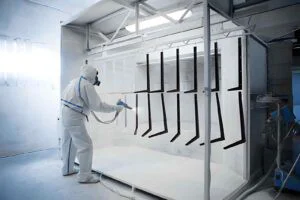
Powder coating is a dry finishing process that applies electrically charged powder particles onto a prepared metal surface. The coated component is then heated in a curing oven, allowing the powder to melt, flow, and form a continuous protective layer.
As a common surface finishing method for machined and fabricated components, powder coating provides strong wear resistance, consistent coverage, and a wide range of colours, textures, and gloss levels.
Powder coating is typically applied after machining, welding, fabrication, and dimensional inspection have been completed.
Because the cured coating forms a permanent film, manufacturers normally complete all operations that may affect the surface before coating begins.
Dry Powder Becomes a Continuous Coating
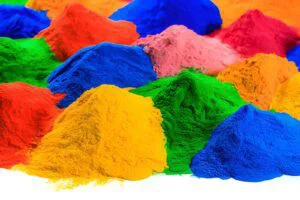
The powder coating process begins by spraying dry powder onto a grounded metal component using an electrostatic charge. The charged particles adhere to the prepared surface before the component enters a curing oven.
During the heating process, the powder melts and flows evenly across the surface, forming a continuous protective coating.
Unlike liquid paint, where multiple wet layers may be applied to achieve the required thickness, powder coating develops its final film properties during the curing process.
The final coating thickness depends on several factors, including:
Powder application settings.
Component geometry.
Electrostatic efficiency.
Curing temperature and time.
Required coating specification.
For this reason, coating thickness should always be verified according to the project requirements rather than judged only by appearance.
Functional Surfaces Need Protection Before Coating
Not every area of a metal component should receive powder coating.
Certain functional surfaces usually require masking before the coating process, including:
Threaded holes.
Bearing bores.
Shaft seats.
Sealing surfaces.
Electrical contact areas.
Precision locating features.
Excess coating thickness on these areas may affect assembly accuracy, component fit, electrical conductivity, or sealing performance.
At Kyoto Prototype, these requirements are typically reviewed during the engineering and drawing review stage to ensure that coating specifications do not interfere with final part functionality.
What Is Painting?
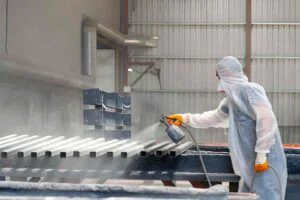
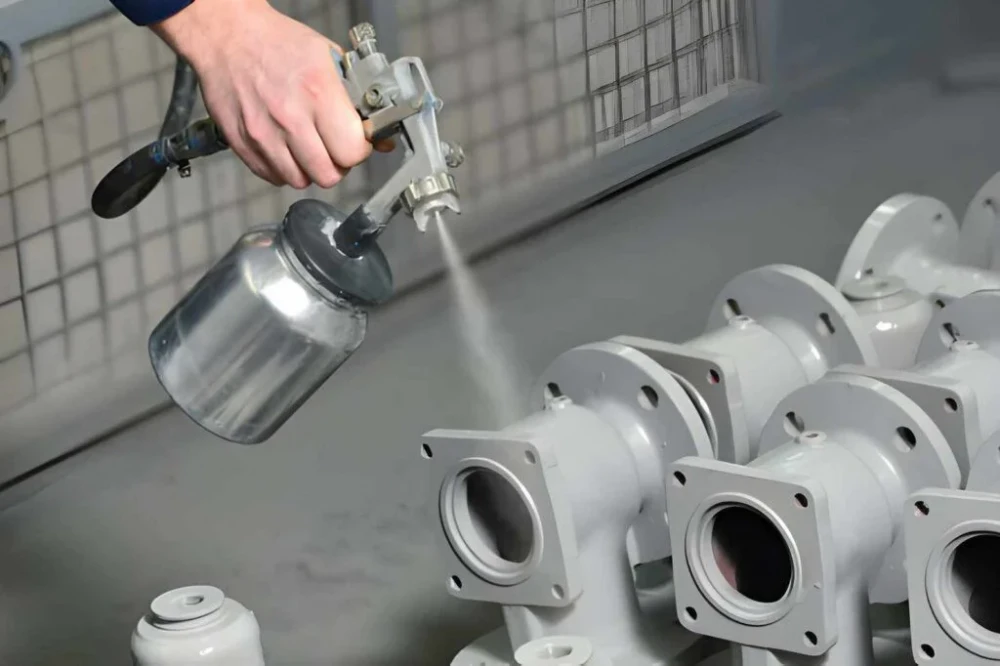
Liquid paint creates a protective surface layer by applying a wet coating material directly onto the prepared component surface.
Depending on the selected paint system, the coating develops through:
Solvent evaporation.
Chemical curing.
Air drying.
Controlled drying environments.
Unlike powder coating, liquid paint does not require high-temperature oven curing for most systems. This makes it suitable for components that contain heat-sensitive materials or cannot fit into industrial curing equipment.
The Coating Builds Through Successive Applications
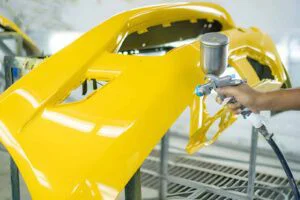
Industrial painting systems commonly consist of multiple coating layers, including:
Primer coat
Improves adhesion and provides corrosion protection.Intermediate coat
Adds film thickness and improves protective performance.Topcoat
Provides the required colour, gloss, weather resistance, and chemical resistance.
The number of coating layers depends on the application environment and required service life.
Compared with powder coating, liquid paint provides greater flexibility because individual layers can be adjusted according to performance requirements.
Painting Simplifies Repair and Large Assemblies
For large fabricated structures, heavy machinery, storage tanks, structural steel, and assembled equipment, liquid paint is often the preferred finishing method.
This is because these products may:
Exceed powder coating oven dimensions.
Require coating after final assembly.
Need future maintenance repairs.
Experience field modifications during service.
One major advantage of paint is repair flexibility. Damaged areas can often be prepared and recoated locally without removing the complete coating system.
This reduces maintenance downtime and avoids unnecessary refinishing of unaffected surfaces.
How Powder Coating Differs From Paint
Powder coating and liquid paint protect metal components through different manufacturing approaches.
The difference is not only the coating material itself. Each process affects:
Manufacturing sequence.
Drawing requirements.
Surface preparation.
Production limitations.
Inspection methods.
Maintenance procedures.
Engineers should evaluate these factors before selecting a finishing process.
The Manufacturing Route Changes
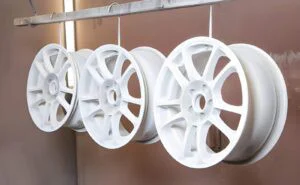
Powder coating is generally applied after all major manufacturing operations have been completed, including:
CNC machining.
Welding.
Sheet metal fabrication.
Drilling.
Grinding.
Dimensional inspection.
Once powder coating has been cured, additional machining or welding becomes difficult because the coating may be damaged.
Liquid paint follows a more flexible production route.
Paint can often be applied:
After assembly.
During installation.
During equipment maintenance.
After final fabrication adjustments.
This makes paint suitable for products with changing production conditions or long service periods requiring maintenance access.
Post-Coating Operations Are Different
Powder-coated components usually require careful planning before coating.
Features such as:
Threaded holes.
Bearing locations.
Gasket surfaces.
Electrical grounding points.
must be identified before processing.
After curing, removing powder coating from these areas requires additional machining or mechanical removal.
Painted components usually require less masking because the coating can often be removed locally during assembly or repair.
This flexibility is one reason why liquid paint remains widely used for large fabricated equipment and low-volume manufacturing projects.
What Should Be Checked Before Powder Coating vs Paint?
Selecting a finishing process should begin with evaluating the condition and requirements of the component rather than choosing a coating method first.
Different manufacturing processes create different surface conditions. CNC machining, welding, laser cutting, casting, and storage can all affect coating performance.
Before selecting powder coating or paint, manufacturers should review:
Base material type.
Surface condition.
Fabrication method.
Required coating thickness.
Service environment.
Dimensional requirements.
Future maintenance expectations.
A proper coating selection process helps prevent adhesion problems, premature coating failure, and unnecessary rework.
The Previous Manufacturing Process Leaves Different Surfaces
The condition of a component before coating depends heavily on the previous manufacturing operation.
For example:
A machined aluminium housing may contain coolant residue around pockets, holes, and threaded features.
A welded steel frame may have:
Weld spatter.
Heat discoloration.
Oxidation.
Grinding marks.
Laser-cut components may develop oxide layers along cut edges, while hot-rolled steel may contain mill scale across the surface.
Because each surface condition is different, preparation requirements should be determined according to the actual component condition rather than following a standard cleaning procedure.
Surface Features Need Individual Attention
Complex geometries require additional consideration before coating.
Flat surfaces are generally easier to prepare and coat. However, certain features require closer inspection, including:
Deep pockets.
Narrow channels.
Internal corners.
Overlapping joints.
Small recesses.
These areas may trap:
Abrasive media.
Cleaning chemicals.
Moisture.
Manufacturing residue.
If contaminants remain trapped, they may appear later as coating defects after curing or drying.
At Kyoto Prototype, engineering review before finishing helps identify these risks early and improves coating consistency for prototype and production components.
How Service Conditions Affect Powder Coating vs Paint
The operating environment often determines coating performance more than the coating method itself.
A component used indoors in a clean environment has different requirements from a part exposed to:
Outdoor weather.
Mechanical impact.
Chemical exposure.
Frequent cleaning.
Abrasive conditions.
Therefore, selecting a finish should begin with understanding how the part will be used throughout its service life.
Abrasion Resistance
Abrasion damage usually appears first on:
Corners.
Handles.
Access panels.
Lifting points.
Frequently contacted surfaces.
These areas experience repeated friction and mechanical contact.
Powder coating generally provides excellent abrasion resistance because it forms a thicker, durable cured film.
For applications where wear is expected, powder coating is often selected for:
Machine guards.
Storage racks.
Electrical enclosures.
Industrial equipment frames.
However, when regular maintenance is expected, liquid paint provides an advantage because damaged areas can often be prepared and recoated locally.
Impact Resistance
Any coating system can be damaged by severe impact.
Examples include:
Dropped tools.
Forklift contact.
Transport damage.
Accidental mechanical impact.
When impact occurs, coating hardness and flexibility influence the damage pattern.
A brittle coating may crack around the damaged area, while a more flexible coating system may absorb impact more effectively.
The repair method also differs:
Powder coating damage often requires more extensive recoating to restore appearance.
Painted surfaces are generally easier to repair locally.
UV Exposure
Outdoor components are continuously exposed to sunlight, and UV resistance becomes an important selection factor.
Powder coatings are available in different chemical formulations.
For outdoor applications:
Polyester powder coatings are commonly selected because of their colour stability.
Epoxy powder coatings are generally preferred for indoor applications because they provide excellent chemical resistance but limited UV performance.
Exterior-grade paint systems can also provide strong long-term colour stability when the correct primer and topcoat system are selected.
The final choice depends on the required outdoor exposure, appearance expectations, and service environment.
Corrosion Protection
Corrosion normally begins when the protective coating system is damaged and the underlying metal becomes exposed.
The coating itself does not eliminate corrosion risk.
Long-term corrosion protection depends on:
Surface preparation.
Pretreatment process.
Primer selection.
Coating thickness.
Complete surface coverage.
For steel fabrications used outdoors, selecting the correct primer system is often as important as choosing the final topcoat.
Examples include:
Zinc-rich primers for corrosion protection.
Epoxy primers for barrier protection.
Polyurethane topcoats for weather resistance.
Chemical Exposure
Before selecting powder coating or paint, manufacturers should evaluate all chemicals that may contact the component during operation.
These may include:
Cleaning agents.
Oils.
Solvents.
Acids.
Alkalis.
Process chemicals.
For mild industrial exposure, standard coating systems may provide sufficient protection.
For aggressive chemical environments, specialized coating systems may be required.
Examples:
Epoxy powder coatings are often selected for indoor industrial equipment exposed to chemicals.
Epoxy primer combined with polyurethane topcoat is commonly used for demanding outdoor and industrial applications.
How Powder Coating vs Paint Influence the Finished Surface
The final surface appearance is evaluated after the coating process is completed.
Beyond colour selection, manufacturers typically inspect:
Coating thickness.
Gloss level.
Surface texture.
Colour consistency.
Edge coverage.
Overall coating uniformity.
These characteristics influence both the visual quality and functional performance of the finished component.
Texture
Powder coating provides a wide range of surface textures, including:
Smooth finishes.
Matte finishes.
Textured finishes.
Wrinkle finishes.
Hammertone finishes.
Textured powder coatings are often selected for fabricated components because they can reduce the visibility of minor surface imperfections caused by:
Welding.
Grinding.
Sheet metal forming.
Fabrication marks.
For applications requiring a highly smooth decorative appearance, liquid paint may provide greater flexibility because multiple layers can be adjusted to achieve the desired surface quality.
Gloss Level
Powder coating generally provides consistent gloss levels across production batches when application settings and curing conditions remain controlled.
This consistency makes powder coating suitable for repeat manufacturing where identical appearance is required across many components.
Liquid paint offers greater flexibility when different gloss levels are required between components or when adjustments need to be made during production.
The final gloss level depends on:
Coating formulation.
Application method.
Surface preparation.
Curing or drying conditions.
Colour Consistency
Powder coating performs well in repeat production because the same powder specification and curing parameters can be maintained throughout manufacturing.
This makes it suitable for:
High-volume production.
Standardized product lines.
Repeated part numbers.
One advantage of paint is future colour matching.
When products require:
Field repairs.
Product modifications.
Engineering changes.
Additional production after long intervals.
Liquid paint systems may provide easier colour adjustment and repair matching.
Film Build and Coating Thickness
Powder coating usually achieves the required dry film thickness through a single application process.
Typical powder coating thickness depends on:
Powder type.
Application settings.
Component geometry.
Required performance specification.
Liquid paint systems usually build thickness through multiple layers:
Primer.
Intermediate coat.
Finish coat.
This allows engineers to adjust each layer according to corrosion resistance, appearance, and service requirements.
During inspection, coating thickness should always be measured according to specification rather than judged only by visual appearance.
Edge Coverage
Sharp edges and corners are typically more difficult to coat evenly than flat surfaces.
Because coating tends to become thinner on sharp edges, proper part preparation is important.
Recommended practices include:
Removing extremely sharp edges.
Applying appropriate edge breaks.
Reviewing complex geometries before coating.
Components with:
Deep channels.
Narrow gaps.
Internal corners.
Complex fabricated structures.
should be reviewed with the coating supplier before production begins.
This helps ensure proper coverage and reduces the risk of premature coating wear.
Powder Coating vs Paint: Production Cost Comparison
The cost of finishing is not determined only by the coating material price.
The actual manufacturing cost depends on:
Equipment investment.
Labour requirements.
Production volume.
Surface preparation.
Coating specifications.
Maintenance expectations.
A lower initial coating cost does not always mean a lower lifetime cost.
A complete evaluation should consider both production efficiency and long-term service requirements.
Equipment and Production Setup
Powder coating requires specialized equipment, including:
Powder spray systems.
Application booths.
Hanging fixtures.
Curing ovens.
The component size must be compatible with the available curing equipment.
For large fabricated structures, this can become a limitation because the part may not fit into the curing oven.
Liquid paint generally requires:
Spray equipment.
Ventilated painting areas.
Drying space.
Since many paint systems do not require high-temperature curing, they are often more practical for:
Large structures.
Heavy equipment.
Field applications.
Oversized assemblies.
Material Usage and Waste
Powder coating has advantages in material efficiency.
Unused powder can often be collected and reused when properly managed, reducing material waste during production.
Liquid paint creates different challenges.
Paint materials:
Require mixing before application.
Have limited working times.
Generate overspray waste.
Require solvent cleaning after use.
These factors can increase material consumption and processing time.
Labour and Batch Size
Production quantity has a significant impact on finishing cost.
Powder coating is highly suitable for repeat manufacturing because the same setup can process many identical components efficiently.
Typical applications include:
Electrical cabinets.
Machine frames.
Sheet metal enclosures.
Industrial brackets.
Standard fabricated components.
Liquid paint provides greater flexibility for:
Prototype parts.
Low-volume production.
Custom fabrications.
Engineering changes.
Replacement components.
When production requirements change frequently, paint may reduce setup time and simplify manufacturing adjustments.
Powder Coating vs Paint: Production Considerations
As discussed throughout this comparison, not every component can follow the same finishing route.
The most suitable coating method depends on:
Part dimensions.
Material properties.
Fabrication process.
Production volume.
Assembly sequence.
Service environment.
Future maintenance requirements.
Selecting the correct finishing process early in the manufacturing plan can reduce production delays, prevent coating failures, and improve overall product quality.
Part Size and Material Limitations
One of the main limitations of powder coating is component size.
Because powder coating requires oven curing, the component must fit within the available curing equipment.
For oversized parts, powder coating may not be practical unless specialized equipment is available.
Material compatibility must also be considered.
Powder coating is generally not recommended after installing:
Plastic components.
Rubber seals.
Adhesive-bonded parts.
Electronic components.
Heat-sensitive assemblies.
The curing temperature, which is commonly around 160–200°C depending on the powder system, may affect these materials.
Liquid paint is often more suitable for completed assemblies containing temperature-sensitive components because it can typically cure at ambient conditions or lower temperatures.
Welded Assemblies and Production Volume
Welded components should be carefully inspected before any coating process begins.
Common fabrication issues that may affect coating quality include:
Weld spatter.
Sharp edges.
Undercut weld areas.
Grinding marks.
Surface contamination.
If these issues are not corrected before coating, they may become visible after finishing and require additional rework.
Production volume also influences coating selection.
Powder coating is often preferred for:
Medium to high-volume production.
Repeat part numbers.
Standardized designs.
Components with stable specifications.
Paint is often preferred for:
Prototype development.
Engineering changes.
Low-volume production.
Custom fabrication.
Replacement parts.
For projects where designs continue to evolve, liquid paint provides greater flexibility.
When Powder Coating Becomes the Better Choice Over Paint
Powder coating becomes a practical solution when the complete manufacturing process has been finalized before finishing.
It is particularly suitable for production environments where identical components are produced repeatedly.
Practical Production Situations
Powder coating is often a good choice when:
CNC machining, welding, drilling, and fabrication are already complete.
The component fits within available curing oven dimensions.
No additional welding or machining is required after coating.
The same design is produced in medium or high quantities.
Consistent appearance is required across production batches.
The product will experience abrasion or frequent handling.
Colour changes are relatively infrequent.
Coating can be completed within a controlled manufacturing environment.
Before Selecting Powder Coating You Must:
Before choosing powder coating, manufacturers should confirm:
1. Dimensional Requirements
Ensure all critical dimensions have been inspected before coating.
Coating thickness may affect:
Assembly fit.
Clearance.
Thread engagement.
Precision locating features.
2. Masking Requirements
Identify all areas requiring protection, including:
Threaded holes.
Bearing surfaces.
Sealing areas.
Electrical contact points.
Precision machined features.
3. Material Compatibility
Confirm that all materials within the assembly can withstand the curing temperature.
4. Component Geometry
Review whether the part design allows:
Complete powder coverage.
Proper drainage during cleaning.
Effective curing.
Access to recessed areas.
When Paint Provides Better Outcomes
Liquid paint is often the better choice when production conditions continue to change after fabrication.
It provides greater flexibility for large structures, assembled products, and projects requiring future repair.
Practical Production Situations
Paint is commonly selected when:
The component cannot fit into a curing oven.
Coating must be applied after final assembly.
Future maintenance repairs are expected.
Product specifications change frequently.
Small production quantities require frequent colour changes.
The assembly contains rubber, plastic, electronic, or heat-sensitive components.
Local repair should be possible without refinishing the entire component.
Painting will be completed at the installation site.
Before Selecting Liquid Paint You Must:
Before selecting a liquid paint system, manufacturers should consider:
Primer Selection
Choose a primer that matches:
The substrate material.
Corrosion requirements.
Service environment.
Drying and Recoating Time
Confirm:
Required drying time.
Recoat intervals.
Production scheduling requirements.
Future Maintenance
Consider how the product will be repaired throughout its service life.
A coating specification should support both initial manufacturing and long-term maintenance needs.
Powder Coating vs Paint: Comparison Summary at a Glance
| Factor | Powder Coating | Paint |
|---|---|---|
| Common coating systems | Polyester, epoxy, epoxy-polyester hybrid, polyurethane powder | Epoxy primer, zinc-rich primer, polyurethane topcoat, acrylic paint, alkyd paint |
| Suitable base materials | Carbon steel, galvanized steel, aluminium, stainless steel | Carbon steel, stainless steel, aluminium, cast steel, cast iron, galvanized steel |
| Typical applications | Machine guards, electrical cabinets, sheet metal enclosures, storage racks, brackets, agricultural equipment | Structural frames, pressure vessels, process skids, storage tanks, trailers, heavy machinery, repair parts |
| Typical coating thickness | Approximately 60–120 μm for decorative finishes; 80–150 μm for industrial applications | Primer, intermediate coat, and topcoat thickness depend on coating specification |
| Production volume | Medium to high-volume repeat manufacturing | Prototype, custom fabrication, low-volume production, maintenance work |
| Large assemblies | Limited by curing oven size and production equipment | Suitable for oversized structures and field applications |
| Heat-sensitive assemblies | Not recommended after installation of heat-sensitive materials | More suitable for completed assemblies |
| Repair work | Local repair possible but colour and texture may differ | Easier local repair and colour matching |
| Outdoor performance | Polyester powder commonly used for outdoor equipment and architectural applications | Polyurethane paint systems widely used for heavy equipment, marine, and industrial structures |
| Chemical exposure | Epoxy powder suitable for many industrial environments | Epoxy primer with protective topcoat suitable for demanding environments |
| Production recommendation | Best for repeat manufacturing after fabrication is complete | Best for flexible production, repair, and large fabricated products |
Need Help Choosing Between Powder Coating and Paint? Contact Kyoto Prototype
Powder coating and liquid paint are two widely used metal finishing methods, but each process is designed for different manufacturing requirements.
Throughout this guide, we compared these finishing methods from a manufacturing perspective, including:
Coating processes.
Surface appearance.
Durability.
Production cost.
Service conditions.
Manufacturing limitations.
Maintenance requirements.
Typical applications.
Choosing the correct finishing process requires more than comparing coating prices. The best solution depends on the complete product lifecycle, including manufacturing conditions, operating environment, and future maintenance expectations.
At Kyoto Prototype, we provide precision CNC machining, sheet metal fabrication, prototyping, and surface finishing services for prototype and production components.
Our engineering team works with customers to evaluate:
Material selection.
Part geometry.
Production requirements.
Surface finish specifications.
Application conditions.
By reviewing your drawings, CAD files, and project requirements, Kyoto Prototype can help identify a suitable finishing solution that balances appearance, performance, and manufacturing efficiency.
Whether you need a prototype component, small-batch production parts, or a scalable manufacturing solution, our team can support your project from initial design review through final production.
Frequently Asked Questions
Is powder coating suitable for machined parts?
Yes. Powder coating is commonly used for machined and fabricated metal components.
However, some precision features should remain free from coating, including:
Threaded holes.
Bearing bores.
Shaft seats.
Sealing surfaces.
Electrical contact areas.
These areas are typically masked before coating to maintain assembly accuracy and functional performance.
Reviewing coating requirements during the engineering stage helps prevent dimensional issues after finishing.
Can powder coating be applied to galvanized steel?
Yes, powder coating can be applied to galvanized steel when the surface is properly prepared.
Fresh galvanized surfaces may contain:
Oils.
Oxides.
Surface contaminants.
These materials can reduce coating adhesion if not removed.
Proper cleaning and pretreatment are important steps to achieve a durable powder-coated finish.
Can damaged powder coating be repaired?
Small areas of damaged powder coating can sometimes be repaired using liquid paint.
However, the repaired area may not perfectly match the original:
Colour.
Texture.
Gloss level.
For components where appearance consistency is critical, manufacturers may choose to remove the existing coating and refinish the complete part.
Which finish is easier to inspect after production?
Both powder coating and paint require inspection to confirm coating quality.
Typical inspection items include:
Coating thickness.
Surface coverage.
Adhesion.
Visual defects.
Curing or drying condition.
Colour consistency.
Inspection requirements should always follow the project coating specification.
How do engineers select between powder coating and paint?
Engineers typically evaluate several factors before selecting a finishing method, including:
Part size.
Material type.
Manufacturing process.
Production volume.
Service environment.
Assembly sequence.
Future maintenance requirements.
Appearance expectations.
Powder coating is often preferred for repeat production with stable designs, while paint provides greater flexibility for large assemblies, custom fabrication, and projects requiring future repairs.
Final Considerations
Powder coating and paint are both effective metal finishing solutions, but their advantages depend on the application.
Powder coating is generally the preferred choice when:
Parts are produced repeatedly.
Fabrication is complete before finishing.
High durability and consistent appearance are required.
The component can be processed through curing equipment.
Paint is often the better option when:
Parts are oversized.
Final assembly occurs before coating.
Field repair is expected.
Production requirements change frequently.
By evaluating manufacturing requirements early, companies can avoid unnecessary rework and select a finishing process that delivers the required performance and cost efficiency.
Kyoto Prototype combines manufacturing experience with engineering support to help customers choose practical surface finishing solutions for prototypes and production components.
 Burr Formation in Aluminum Machining: Here are the causes and practical solutions.


